
Despite persisting questions among peer officers in the army about his professional competence and ethics, after his recent 'triumphal' Kabul sojourn, Faiz Hameed remains the hot favourite of both General Bajwa and Prime Minister Imran Khan, notes Rana Banerji, who headed the Pakistan desk at the Research and Analysis Wing.

The arrival a couple of days ago of a Chinese nuclear submarine for the first time in Karachi port, coinciding with a Chinese military delegation's visit, points to Pakistan's importance for China, says former R&AW officer Jayadeva Ranade.

Today, he lies in an unknown grave in a corner of a farmer's field in Pakistan, having given his all for his country. A riveting excerpt from Ian Cardozo's Beyond Fear: True Stories on Life in the Indian Armed Forces.

'You have been surrounded from all directions, if you want the safety of your troops and your personal safety, we will give you eight hours to make up your mind to surrender.'

16 Indian Army divisions face China, 20 face Pakistan and two divisions are reserves. This powerful signal can hardly be missed in China or Pakistan, notes Ajai Shukla.
As India's international role expands, so must our capabilities, says Brigadier Gurmeet Kanwal (retd).
Brigadier Gurmeet Kanwal (retd) lists why India must not do away with AFSPA, but ensure enough transparency to avoid confrontation with human rights.

One of the most sought after exhibitions in Asia, as many as 549 companies are participating this year with 53 fighter aircraft on display.

Keeping the contents of the BBC documentary aside, Rishi Sunak's response needs to be viewed in the backdrop of Britain's historically close relations with Pakistan, argues Lieutenant General Prakash Katoch (retd).

Babu R was trapped in a mountain gorge without food or water for two days till the Indian Army rescued him in a daring mission.

Until last month more than two-thirds of the Indian Army was deployed against Pakistan. Of 14 army corps, just four-and-a-half faced China, while more than twice that number was ranged against Pakistan.

Just 21 then, a young air force officer looks back at the 1971 war, which was like a baptism by fire in the fauj.

NIA was on Monday allowed by a special court to conduct a lie-detector test on senior Punjab Police officer Salwinder Singh in connection with the Pathankot terror attack probe.
Air Vice Marshal Arjun Subramaniam lists the major operational takeaways from the 1971 War in his new book 'India's Wars, A Military History, 1947-1971'.

'Pakistan's recent utterances and tendency to use pinpricks to try our patience appear reminiscent of 1965. We are a strong nation, emerging stronger,' says Lieutenant General Syed Ata Hasnain (retd).
'Today's India is fearless and is on track to be a great power. But this is definitely not happening without women, who form 48 per cent of our population.'

The plan hinged on two critical assumptions: India would not be able to replenish supplies quickly to launch a counter-attack. India could not respond in enough strength to dislodge the Pakistanis. Both assumptions would be proved wrong due to the ferocity of the Indian response, reveals former RAW officer Tilak Devasher in his new book, Pakistan At The Helm.

Gurmeet Ram Rahim also made an appeal to his followers to go back to their homes, a development which may come as a big relief to security personnel.
In a faux pas, NSG Chief R C Tayal on Tuesday claimed his men defused an Improvised Explosive Device recovered from high-security DRDO Bhawan after "no other agency" could handle the situation, but it later turned out to be a bomb of World War II vintage.

The perpetrators of the 2008 Mumbai attack, who shot dead 166 people, had confessed to details that should have been enough to hang him, but Pakistan enjoyed his anti-India rhetoric and let him spread his tentacles. A revealing excerpt from Khaled Ahmed's Pakistan's Terror Conundrum.
'Any conventional conflict could trigger a nuclear war with results that neither India nor Pakistan could survive easily.' >A revealing excerpt from Shuja Nawaz's The Battle For Pakistan: The Bitter US Friendship And A Tough Neighbourhood.
Accurate and sustained firepower against Pakistan during the Kargil War helped Indian soldiers to reduce the enemy to rubble.
'The Himmatsinghji Report is still 'missing'.' 'It is a great loss for the knowledge of India's borders.' 'It would have an immense value at a time China is bound to shift its attention to other border fronts in the Himalayas,' notes Claude Arpi.
'Already, there is talk of a possible extension for Raheel Sharif in the context of his perceived sterling, but incomplete work in the war against terror, as also the cleansing of crime and extortion networks in Karachi,' says Rana Banerji.

'Intrusions by PLA troops in the Ladakh sector are more in number than elsewhere and this region is now likely to remain an area of enhanced Chinese interest,' warns China expert Jayadeva Ranade.

India and China met and spoke a lot this year, but failed to produce any meaningful results.
'A conventional war is not in fashion today and not seen as being able to deliver the objective.' 'Perhaps surgical strikes that are deeper, this time not on Pakistan's terrorist facilities, but on Pakistan army facilities.' 'The nation has to be prepared for losses.' 'War is not something that can be pussyfooted around.' 'If we go for limited number of posts in Kashmir, these are very difficult posts to capture and very difficult operations.' 'Be prepared for 200 to 300 killed.'

'We owe our existence to the men in uniform, and we owe it to them to cleanse the armed forces by driving away every bit of corruption that eats into it,' argues Sudhir Bisht.
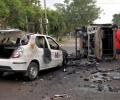
The situation in Sirsa remained tense but under control, according to police.

'We were firing at Patton tanks that were moving towards India.' 'Fighter aircraft are the biggest menace for tanks because they come at great speed, attack from a height and their rockets are lethal.' 'The Hunter travels at 400, 420 knots. One knot is 1.6 times a km, so it was at a speed of 700, 800 km/hr.' 'You come at great speed and when you see the tanks, you pull up because attacks are always done in a dive.' 'You go up to 3,000 to 4,000 feet and then dive on to the target and let off your rockets...'

In insight into PNS Ghazi, the Pakistan Navy's prized submarine that now lies embedded in the Vizag seabed about 1.5 nautical miles from the breakwaters.

During a war, there are just four possibilities a soldier faces. One: Victorious and safe. Two: Wounded. Three: Killed in action. Four: Prisoner of War. It was my fate to face the fourth, says Colonel Anil A Athale (retd) on the year spent as a prisoner of war in Pakistan during the 1971 War.

'The Chinese mindset and approach to India is far different from that in Pakistan.' 'This reality makes it possible for us to follow an engagement policy with one, while militating against engagement with the other.'

Very few today realise that without Brigadier John Dalvi's courage, we would never have known what really happened during those tragic days of October/November 1962, reveals Claude Arpi.

The Emergency greatly influenced the RSS' makeover from a fringe force in the Indian political imagination to one that could have its own man sworn in as prime minister in two decades' time. A riveting excerpt from Christophe Jaffrelot and Pratinav Anil's India's First Dictatorship: The Emergency, 1975-1977.

The British administration ignored the mounting evidence of violence between Hindus and Muslims... Military historian Barney White-Spunner traces the countdown to the tragedy in his book, Partition.

Lieutenant General J F R Jacob, Chief of Staff, Eastern Army Command during the 1971 war, revealed how, armed with only a draft surrender document and an aide, he made the Pakistani army led by Lieutenant General A A K Niazi surrender.
Lieutenant General J F R Jacob, Chief of Staff, Eastern Army Command during the 1971 war, revealed how, armed with only a draft surrender document and an aide, he made the Pakistani army led by Lieutenant General A A K Niazi surrender.
Lieutenant General J F R Jacob, Chief of Staff, Eastern Army Command during the 1971 war, revealed how, armed with only a draft surrender document and an aide, he made the Pakistani army led by Lieutenant General A A K Niazi surrender.
Lieutenant General J F R Jacob, Chief of Staff, Eastern Army Command during the 1971 war, revealed how, armed with only a draft surrender document and an aide, he made the Pakistani army led by Lieutenant General A A K Niazi surrender.
